




Ram: From Logo to Model to Brand

Juliet once asked, “What’s in a name?” While Shakespeare wrote that line to imply that a name is just a convention if it has no meaning behind it, a name can mean everything when it comes to product branding. This is why folks are always looking for a “Ram dealer near me” online when they are in the market for a rugged and dependable pickup truck. That is because the name Ram has become synonymous with quality trucks. It also doesn’t hurt that the LA Rams just won the Super Bowl, showing that a ram is more than just a male sheep. It is a tough, powerful beast that will knock over any opponent in its way.
However, Ram didn’t start as a truck brand or even a model. It was a logo, a symbol of promise for what a Dodge truck could deliver to a driver. This is why Dodge chose the Ram as the symbol for its trucks. When you stop into Zimmer Chrysler Dodge Jeep Ram, we will show you why you should make your next truck a Ram. No matter which model you buy, you will see why a Ram earns its name every day, building on the legacy of the history of the Ram logo.
In the Beginning, Ram Was a Hood Ornament
In today’s automotive world, hood ornaments have gone the way of shoes with spats and men in top hats. Few cars sport this once ubiquitous item. Jaguar has tamed its big cat, while Mercedes-Benz embedded its famous standing hood ornament into the hood itself. These days, unless you want to part with half a million dollars to get a Rolls-Royce with its Spirit of Ecstasy standing ornament, you will have to go without a hood ornament. However, in the early days of the automobile business, hood ornaments were a big deal. This is why the Dodge Brothers hired famed American sculptor Avard Tennyson Fairbanks to create a hood ornament to adorn the company’s cars. Fairbanks had already created the Flying Lady radiator caps for Chrysler. This winged mermaid adorned Chrysler and Plymouth cars starting in 1932, quickly becoming an automotive industry icon, so Dodge knew they could count on him. What he came up with started a legend.
The folks at Dodge were looking for a hood ornament for roughly 10,000 cars, and they wanted one to rival the Spirit of Ecstasy on the Rolls-Royce. However, the cars they were selling were not super luxury models but rather ones designed for ordinary drivers. Fairbanks started modeling different animals until he came up with a mountain sheep with its sleek, curved horns. This tough, ornery beast is known as a trail master that isn’t afraid of any predator, making it ideal for the cars and trucks that Dodge was producing. Fairbanks convinced Walter Chrysler, the leader of Dodge Chrysler Plymouth, and the Ram began to appear on every car and truck produced by Dodge in 1933. That Ram hood ornament would keep rolling along for the next two decades before being phased out in 1954. However, that was not the end of the Dodge Ram.
Dodge Brings Back the Ram as a Model
The year was 1981. Reagan had just taken office as President, men were wearing mullets, and moviegoers were turning out in droves to see Raiders of the Lost Ark. Just like Indiana Jones looking for the lost Ark of the Covenant, Chrysler President Lee Iaccoca searched through Dodge history for its new lineup of trucks. Iaccoca decided that nothing was tougher than a ram, and since Dodge controlled the name Ram, it made perfect sense to bring back the Ram truck.
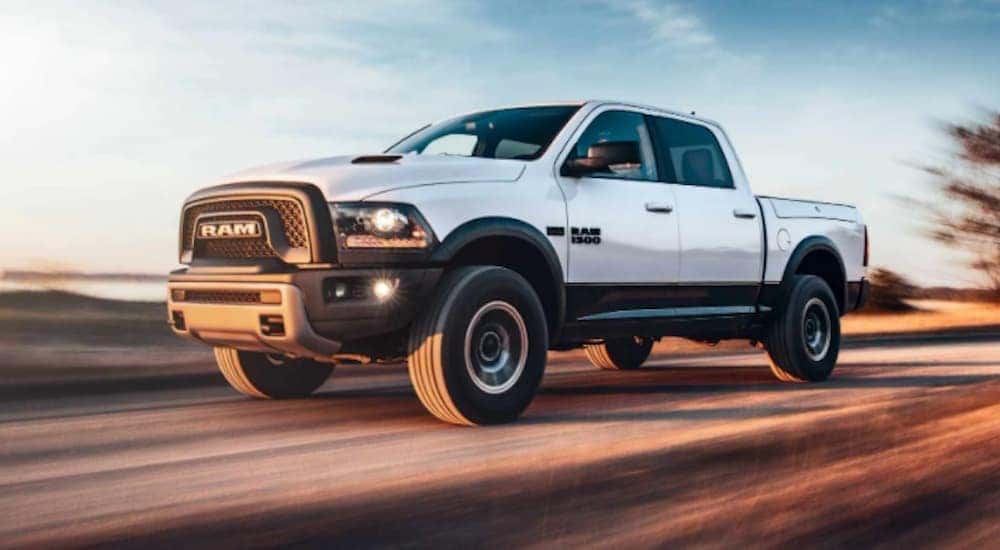
The first decade of Dodge Ram trucks saw the company produce three models—the full-size half-ton 150, the three-quarter-ton 250, and the one-ton payload capable 350. This would start a trend of Ram trucks offering three different sized models, which continues to this day, although with different numbers. In addition, Dodge Ram offered drivers a choice of four-wheel drive for greater traction, and rear-wheel drive for improved payload and trailering capabilities.
To market these trucks, Chrysler introduced the Dodge Ram logo in 1993, a red stylized ram’s head inside a pentagonal shield with the name DODGE written out underneath in black block letters. This would continue as the logo with some variations over the ensuing 25 years, including one with the image and name in metallic silver.
Those first Dodge Ram trucks were fairly utilitarian in looks, but they made up for their basic appearance with rugged dependability and performance. This came courtesy of three engines. These were a 3.7-liter slant-6 with 95 horsepower, a 5.2-liter V8 with 140 horsepower, and 5.6-liter V8 with 175 horsepower. Drivers also got to choose between a two-door regular cab with one row of seats, a two-door Club Cab with two rows of seats, and a top-line Crew Cab with four rows of seats. By the end of the decade, Dodge Ram had staked its place as a leader in pickup trucks. They phased out the slant-6 for a 3.9-liter V6 with 125 horsepower while upgrading both of the V8 engines, and adding a 5.9-liter Cummins turbo-diesel I-6 that became a best seller for the lineup.
The second generation of Dodge Ram trucks hit the road in time for the 1994 model year. These were not only sleeker, with cleaner lines and a more aerodynamic profile, but also had a new numbering system. The 150 became 1500, the 250 was now the 2500, and the 350 morphed into the 3500. This numbering system continues with today’s Ram trucks. Dodge Ram also upped the ante by offering five engine choices, battering down the competition with greater options. These included a 3.9-liter V6 with 175 horsepower, a 5.2-liter V8 with 230 horsepower, a 5.9-liter V8 with 230 horsepower, a 5.9-liter Cummins turbo-diesel I6 with 175 horsepower and 420 lb-ft of torque, and a truly insane 8.0-ilter V10 engine with 300 horsepower and 450 lb-ft of torque.
Starting with the 1994 model, drivers could purchase a Dodge Ram truck with a 10-cylinder gas engine. Dodge Ram would continue to offer this engine option on the 2500 and 3500 models until the 2003 model year when an even bigger 8.3-liter viper V10 replaced it on the SRT-10 model. Eventually, calmer heads and rising gas prices prevailed as the 10-cylinder engine was discontinued on the Dodge Ram truck after 2006.
The last generation of the Dodge Ram truck debuted for the 2002 model year, which included the available 10-cylinder engines on the two larger models. Drivers were offered a choice of a two-door regular cab, a Quad Cab, or a Mega Cab, each of the last two featuring four full-size doors. The looks continued to keep up with the time, while the frame, suspension, and interiors were also upgraded. This was a new Dodge Ram truck for a new generation, with choices of a 3.7-liter V6 with 215 horsepower, a 4.7-liter V8 with 235 horsepower, a 5.7-liter Cummins turbo-diesel I6 with 325 horsepower, and those 10-cylinder monster engines. The third generation of the Dodge Ram truck was proving so popular that folks at Dodge seemed to be spending a great deal of time working on these trucks. This would lead to the last change in the development of the Ram logo.
A Ram Brand All Its Own
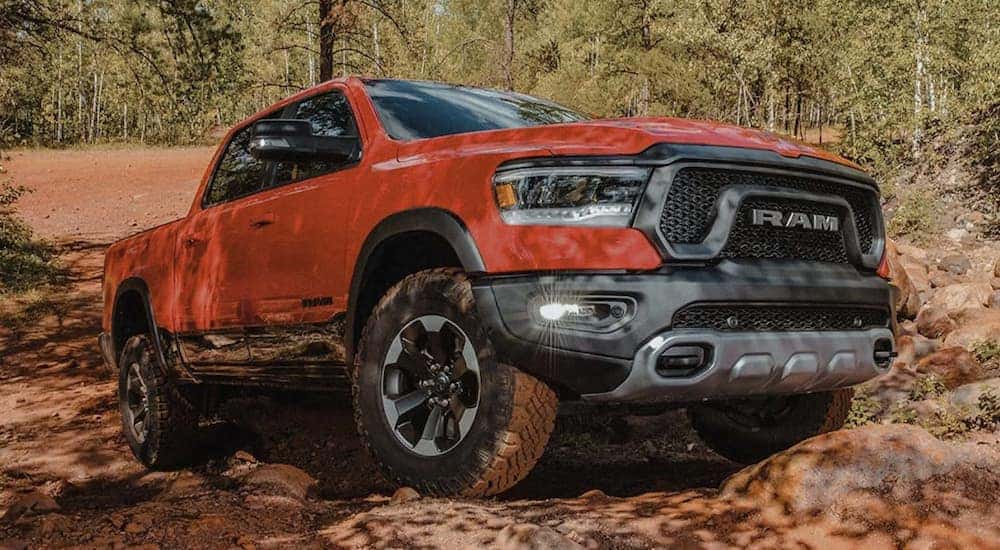
In 2009, the leadership at Chrysler decided that it was time for Dodge and Ram to part company. As breakups go, this was truly amicable, much less bitter and acrimonious than Kim and Kanye. Ram became its own division, focused solely on trucks, while Dodge would now be able to focus on its lineup of rugged SUVs like the Durango and sporty fastbacks like the Charger and Challenger. Nevertheless, the two separate brands would often share technological know-how, like the HEMI V8 engine featured on many Ram trucks, like the 2022 Ram 1500 with the 5.7-liter HEMI “Eagle” V8.
Ram needed a new logo for its new company, and the design team did not disappoint. This one is a three-dimensional ram’s head in metallic silver on a black pentagonal shield with a silver metallic border. Underneath is written RAM in bold, black letters. Since its introduction in 2009, this logo has had a few different looks, like a metallic gold one on some models. Nevertheless, the Ram logo has continued on all of the brand’s trucks, signifying its dedication to those first trucks to bear the ram hood ornament back in 1933.
The Ram Symbol Signifies Value
As a truck driver, you know the need for a vehicle that is rugged, dependable, capable, and able to perform all the tasks you need done. This is why Ram stands out from its competitors, able to beat all comers like the bighorn sheep that serves as the model for its logo. This tenacious animal rules the Rocky Mountains like you will rule the road in your Ram truck. Find out that Ram is more than just a name today when you stop into our dealership to get your next truck.
0 comment(s) so far on Ram: From Logo to Model to Brand