




Which Jeep SUV is Right for You?

Not counting the one-of-a-kind Jeep Wrangler, Jeep currently offers four different SUVs to choose from. And at first glance, all of these Jeep models are fairly similar. While the Jeep Renegade‘s styling is dramatically different from that of the Jeep Compass, Jeep Cherokee, and Jeep Grand Cherokee, they are not that far apart in size, and even their price ranges have a lot of overlap depending on the trims in question.
The Jeep Grand Cherokee is in a different league than the other three, offering far more power and luxury but not necessarily more space. The Jeep Cherokee and Jeep Compass are actually quite similar in their base configurations, but the former has more options and can roughly rival a base Jeep Grand Cherokee when properly equipped. Finally, the Jeep Renegade is noticeably smaller but offers better performance than a Jeep Compass at a similar price.
So how can you decide which Jeep SUV is right for you? As with any car, it is impossible to fully understand a vehicle without test driving it. But here are some tips to narrow things down before heading to the dealership.
Room for Adventure
In terms of overall length, there is almost exactly two feet of difference between the Jeep Compass and the Jeep Grand Cherokee, with the other two models splitting the difference fairly evenly. But despite these differences in length, all four of these Jeep models are five-seat SUVs. This means that the additional size only translates to increased comfort and cargo storage rather than greater passenger capacity. And because the four SUVs are configured differently, the improvements are not linear.
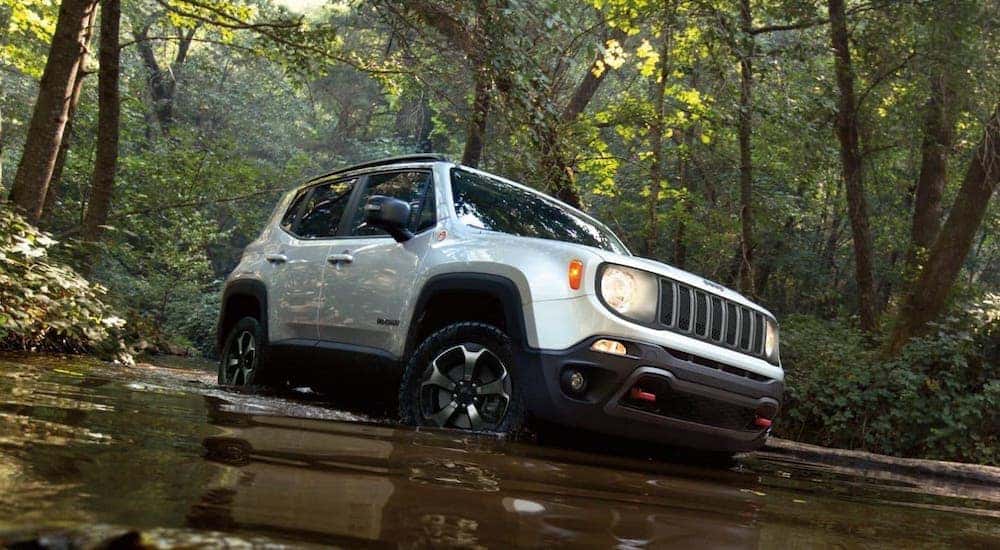
The interior layout of the Jeep Renegade is really best suited for use as a two-person vehicle. The second row has fairly cramped legroom with 35.1 inches of legroom, and there is only 18.5 cubic feet of cargo space with the back seats in place. However, if passenger space is not a priority, then the front row actually has more headroom than even the Jeep Grand Cherokee, and when the rear seats are folded the Renegade has a solid 50.8 cubic feet of cargo space. In many ways, the Jeep Renegade can be thought of as a more conventional counterpart to the two-door Jeep Wrangler.
But if a comfortable third row of seats is a requirement, then the other three Jeep models are all very similar. The Jeep Compass has the least rear legroom at 38.3 inches, but the Jeep Grand Cherokee is only slightly better at 38.6 inches. The most comfortable third-row actually goes to the Jeep Cherokee with its 40.3 inches of legroom, although it does have about an inch less rear headroom than the Jeep Grand Cherokee.
The real difference in interior space between these three SUVs is not in passenger volume but in cargo volume. Here, the Jeep Cherokee brings up the rear with between 25.8 and 54.7 cubic feet depending on whether the rear seats are folded, while the Jeep Compass is slightly ahead with between 27.2 and 59.8 cubic feet of cargo space. But if moving large items is your primary concern, then your best bet is the Jeep Grand Cherokee, which sports an excellent 36.3 to 68.3 cubic feet of cargo space. This more than makes up for its middle-of-the-pack passenger space, as it allows the Jeep Grand Cherokee to fit plenty of baggage even when its rear seats are occupied.
Power to Explore
While there are some important dimensional differences between these four Jeep models, probably the largest difference is found in their drivetrains. This may be surprising, as the Jeep Compass, Jeep Renegade, and Jeep Cherokee all share the same standard engine. However, their top engines are quite different, and the Jeep Grand Cherokee stands out from the pack with both a far more powerful base engine and some truly incredible optional engines.
The base engine shared by the three smaller Jeep SUV models is a 2.4L Tigershark four-cylinder that produces 180 horsepower and 175 lb-ft of torque. This level of power is quite comfortable in the lighter Jeep Compass and Jeep Renegade, although it does lose some of its edge in the heavier Jeep Cherokee. And while it may not be the most powerful option, the base engine is fairly efficient and is rated for 25 MPG combined in the Jeep Compass and Jeep Cherokee, and 26 MPG combined in the Jeep Renegade. But if you do want more power than this, you can cross the Jeep Compass off of your list as it is only available with the base engine. The Jeep Renegade is not much better as it only offers an additional choice of a 1.3L turbo with 177 horsepower and 210 lb-ft of torque. However, while this is a small drop in horsepower, the added torque of this engine will make the Jeep Renegade feel much lighter on its feet, and the more powerful engine is also more efficient with a 27 MPG combined fuel economy.
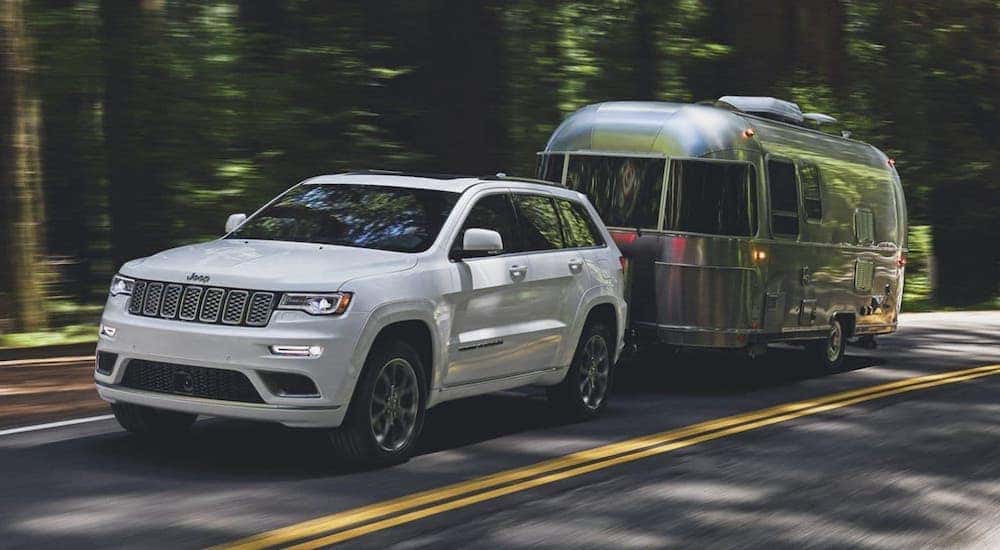
For the Jeep Cherokee, you have two other engine options. These consist of either a 2.0L that generates an excellent 270 horsepower and 295 lb-ft of torque while providing a slightly better fuel economy of 26 MPG combined, or a traditional 3.2L Pentastar V6 with 271 horsepower and 239 lb-ft of torque. But while the V6 is less efficient and less powerful, it does have a slightly higher 4,500-pound tow rating instead of the 4,000-pound rating of the 2.0L turbo. However, both of these engines are a significant step up from the 2,000 pound tow rating that is shared by the base engine, the Jeep Compass, and the Jeep Renegade. Still, those seeking true performance will not be content with even the Jeep Cherokee’s upgraded engines and should instead look to the Jeep Grand Cherokee.
Unlike the other three Jeep SUV models, the Jeep Grand Cherokee is a rear-wheel-drive vehicle that can better handle the increased power, and its engine options more than live up to this potential. The base engine in the Jeep Grand Cherokee is a 3.6L Pentastar V6 with 295 horsepower and 260 lb-ft of torque, making it more powerful than the other three SUVs right out of the gate. And if that is not enough, then the higher trims of the Jeep Grand Cherokee offer three different V8 options. The most common of these is an optional 5.7L HEMI with 360 horsepower and 390 lb-ft of torque, but the Grand Cherokee SRT comes standard with a 6.4L SRT V8 that produces 475 horsepower and 470 lb-ft of torque. Finally, the Grand Cherokee Trackhawk is equipped with an incredibly powerful 6.2L supercharged V8 with no less than 707 horsepower and 645 lb-ft of torque, allowing it to easily hold its own with even luxury imports.
An Informed Choice
When it comes to other aspects of these four Jeep models, such as features and technology, the differences are fairly close. They all offer rather similar styling and share the same Uconnect infotainment system. Of course, the larger and more expensive models offer more standard luxuries, but even the smaller two SUVs offer some fairly luxurious configurations, and all of them are available with large panoramic sunroofs for a true Jeep experience. Now that you have some more information on which Jeep models best fit your needs, it is time to head to the dealership and find the perfect SUV configured exactly how you want it.
0 comment(s) so far on Which Jeep SUV is Right for You?